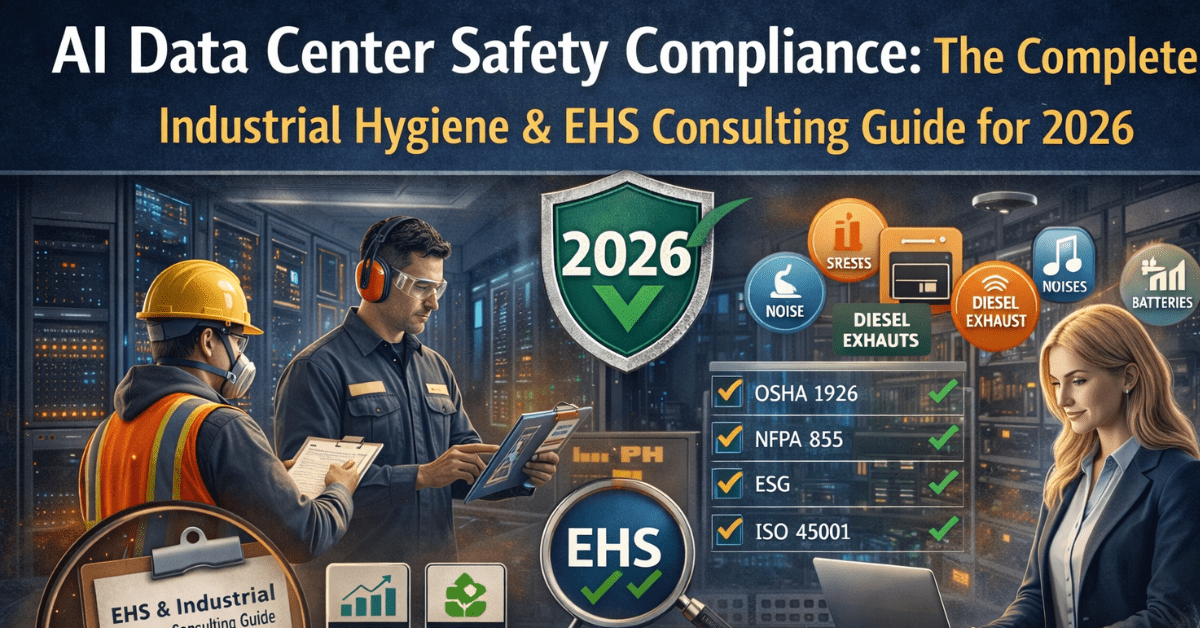
AI Data Center Safety Compliance: The Complete Industrial Hygiene & EHS Consulting Guide for 2026
Artificial intelligence is reshaping nearly every industry, but behind every powerful AI system is a network of massive data centers running 24/7. The rise of modern AI data centers is not just a technological marvel — they are a complex industrial environment where workers face serious occupational hazards. That is why AI data center safety compliance is now one of the most critical responsibilities for owners, developers, and operators in 2026.
As AI infrastructure expands across the United States, companies must move beyond traditional IT safety thinking and adopt true industrial hygiene and environmental health strategies. Phase Associates has emerged as a national leader in helping organizations meet modern safety demands through independent evaluations, OSHA compliance training, air quality monitoring, and comprehensive EHS consulting for AI data centers.
Why AI Data Center Safety Compliance Is Now Mission-Critical
AI data centers operate at higher densities, higher temperatures, and higher energy loads than traditional server facilities. This evolution introduces a wide range of health and environmental risks that demand specialized oversight.
Without proper AI data center safety compliance, organizations expose themselves to:
• OSHA violations and fines • Worker illness and injury claims • Regulatory shutdowns • Project delays and lost productivity • Long-term liability and reputational damage
The reality is simple — AI data centers are no longer just tech spaces; they are industrial workplaces requiring full-scale industrial hygiene programs.
Industrial Hygiene in AI Data Centers: What Must Be Monitored
Effective AI data center safety compliance starts with understanding the hazards workers face daily regarding industrial hygiene in AI data centers; therefore, industrial hygiene data center programs should evaluate the following:
Indoor Air Quality (IAQ)
Dust, chemical vapors, cleaning solvents, ozone from electrical equipment, and byproducts from cooling systems can degrade air quality. Without regular indoor air quality testing in data centers, contaminants often go unnoticed until health complaints arise.
Heat Stress & Thermal Hazards
AI workloads generate extreme heat loads. Inadequate ventilation or cooling failures can lead to heat stress, dehydration, and even heat stroke for technicians working in hot aisles or confined mechanical rooms.
Noise Exposure
Large cooling fans, power distribution systems, and generators produce noise levels capable of causing long-term hearing damage. OSHA requires exposure monitoring and hearing conservation programs — yet many facilities fail to conduct proper noise surveys.
Chemical & Coolant Exposure
Coolants, refrigerants, fire suppression agents, and cleaning chemicals present inhalation and skin contact risks. Industrial hygiene testing ensures exposure limits are not exceeded.
Electromagnetic Fields (EMF)
With AI systems pushing unprecedented electrical loads, concerns around EMF exposure are rising. Environmental health monitoring data center programs now increasingly include EMF assessments.
Building a Comprehensive AI Data Center Safety Compliance Program
A modern AI facility must implement a layered EHS strategy — not a checklist. AI data center safety compliance requires a living program built on monitoring, documentation, training, and continuous improvement.
Step 1: Baseline Industrial Hygiene Assessment
Before occupancy or expansion, Phase Associates conducts AI data center industrial hygiene testing services, including air sampling, noise mapping, heat stress evaluations, and chemical exposure assessments.
Step 2: OSHA Compliance Review
Every facility must comply with federal and state OSHA standards. This includes respiratory protection, hazard communication, hearing conservation, and electrical safety programs tailored to the AI data center environment.
Step 3: Environmental Health Monitoring Programs
Long-term AI data center environmental monitoring programs ensure that changing workloads or equipment do not introduce new risks. Continuous IAQ, noise, and thermal monitoring is becoming standard in hyperscale facilities.
Step 4: Employee Training & Certification
OSHA safety training for AI data centers must reflect the specific hazards present — not generic office-level courses. Phase Associates delivers site-specific training that aligns with OSHA mandates.
Construction-Phase Risks in AI Data Centers
Safety compliance doesn’t begin at ribbon cutting — it starts at groundbreaking. Construction of AI data centers introduces serious hazards, including:
• Silica exposure from concrete cutting • Welding fumes during mechanical installations • Heavy equipment noise exposure • Confined space hazards • Poor ventilation in build-out phases
Without proper controls, construction workers face long-term respiratory illnesses. Phase Associates provides independent construction-phase EHS audits to protect workers and ensure projects remain compliant from day one.
Why Independent EHS Evaluations Matter
Too many data centers rely on internal safety checklists or equipment vendors to manage risk. This is a dangerous mistake.
Independent evaluations remove bias and uncover overlooked hazards. As AI facilities become more complex, independent EHS evaluations for data centers are the only reliable way to validate compliance.
Phase Associates’ third-party assessments identify gaps before OSHA or insurance auditors do.
OSHA Compliance Data Centers Must Prioritize
OSHA enforcement is intensifying in high-energy facilities, including hyperscale AI operations. Failure to meet AI data center safety compliance standards often stems from:
• Incomplete respiratory protection programs • Lack of documented exposure monitoring • Missing hazard communication training • Outdated hearing conservation plans • Failure to track indoor air quality testing in data centers
Every violation increases liability exposure — especially when combined with rapid AI expansion schedules.
Environmental Health: The Hidden Risk Category
Environmental health monitoring data centers and programs go beyond employee safety. They address the facility’s impact on the surrounding community.
• Noise pollution complaints • Diesel generator emissions • Heat exhaust impacts • Chemical storage and disposal
These risks increasingly attract attention from local regulators and community organizations.
In today’s environment, safety failures in AI data centers attract not only regulators but also plaintiffs’ attorneys, insurance investigators, and media scrutiny.
Phase Associates Is the Trusted Partner for AI Data Center Safety Compliance
Phase Associates specializes in:
• Industrial hygiene data center programs • OSHA compliance data center training • AI data center environmental monitoring programs • Independent EHS evaluations for data centers • Construction-phase safety oversight
The multi-state footprint allows rapid response nationwide, supporting hyperscale operators, developers, and facility managers from concept to commissioning.
Ready to Protect Your AI Data Center?
As AI data centers continue to expand across the country, ensuring worker safety, OSHA compliance, and proper industrial hygiene monitoring is no longer optional — it’s mission-critical.
Phase Associates provides industrial hygiene testing, OSHA safety and compliance training, and environmental health services nationwide, with established offices in:
New Jersey (Atlantic City), New York City, Pennsylvania (Philadelphia & Pittsburgh), Georgia (Atlanta), Maryland (Baltimore & DC Area), Massachusetts (Boston), Michigan (Detroit), Arkansas (Bentonville), and surrounding areas.
Whether you’re planning a new AI data center, commissioning a hyperscale facility, or need ongoing EHS monitoring and training, Phase Associates delivers the independent evaluations and regulatory guidance needed to protect your workforce and your operation.
Industrial Hygiene in AI Data Centers: Risks to Air, Noise and Heat
Artificial intelligence (AI) workloads are transforming modern data centers into dense, high-energy industrial environments. What were once quiet technical spaces are now facilities filled with powerful cooling systems, massive electrical infrastructure, and continuous human activity. As a result, industrial hygiene in AI data centers has become one of the most important areas of environmental health and safety in 2026, as the rise of modern AI data centers is seeing rapid growth, expansion, infrastructure acceleration and market demand.
Unlike traditional IT rooms, AI facilities generate persistent heat, noise, airborne contaminants, and chemical exposure risks and occupational hazards that directly impact the health of employees working in server rooms, cooling corridors, electrical vaults, and mechanical spaces.
Why Industrial Hygiene in AI Data Centers Is No Longer Optional
The goal of industrial hygiene is to identify, evaluate, and control workplace hazards that can cause illness or injury. In the context of AI operations, this means protecting technicians from long-term exposure to harmful conditions that are often invisible.
Without formal industrial hygiene in AI data centers programs, organizations are exposed to:
• OSHA citations and regulatory penalties • Rising workers’ compensation claims • Increased absenteeism and turnover • Reduced operational efficiency • Long-term liability and insurance risk
AI expansion has turned safety oversight into a business-critical function, not a support task.
Air Quality Risks Inside AI Data Centers
Air quality is one of the most underestimated exposure hazards in modern facilities. Industrial hygiene in AI data centers includes routine monitoring and industrial hygiene testing for:
• Particulate matter from equipment movement and floor traffic • Vapors from solvents, lubricants, fire suppression agents, and cleaning products • Diesel exhaust infiltration from backup generators • Ozone generated by high-voltage electrical equipment
Indoor air quality testing frequently reveals elevated levels of contaminants that may cause respiratory irritation, fatigue, headaches, and long-term pulmonary effects.
AI server racks generate extreme heat loads, pushing cooling systems to their limits. During peak loads or equipment failure, temperatures in hot aisles and confined spaces can rise rapidly.
A comprehensive industrial hygiene in AI data centers program includes heat stress monitoring to evaluate:
• Ambient temperature and humidity • Work duration in high-heat zones • Employee hydration and rest cycles • Emergency response readiness
Heat stressnow ranks among the fastest-growing occupational health concerns inside hyperscale facilities.
Noise Exposure Hazards
Large HVAC systems, air handlers, power distribution units, and generators produce constant background noise that can exceed OSHA thresholds. Without proper monitoring, workers may suffer gradual hearing loss.
Noise surveys are a core part of industrial hygiene in AI data centers, ensuring:
• Accurate decibel mapping • Identification of high-risk work zones • Implementation of hearing conservation programs • Selection of proper personal protective equipment
Chemical & Coolant Exposure
AI data centers rely on numerous chemicals to function safely, including refrigerants, dielectric fluids, fire suppression agents, and cleaning compounds. These substances present inhalation, skin contact, and emergency exposure risks.
Industrial hygiene in AI data centers evaluates:
• Proper chemical storage and labeling • Exposure pathways and ventilation efficiency • Spill response planning • Compliance with OSHA Hazard Communication standards
For facilities subject to federal oversight or development review, chemical management and environmental impact considerations may also intersect with requirements under the National Environmental Policy Act (NEPA).
Building an Industrial Hygiene Program for AI Data Centers
A proactive program is not a one-time inspection. Effective industrial hygiene in AI data centers requires a lifecycle approach:
Baseline exposure assessments before occupancy
Routine air quality, noise, and heat stress monitoring
Chemical exposure evaluations
Annual reassessments as workloads scale
Documentation aligned with OSHA and insurance requirements
Independent Testing Makes the Difference
Internal teams often lack specialized equipment or an unbiased perspective. Independent evaluations ensure that industrial hygiene in AI data center programs is accurate, defensible, and audit-ready.
Third-party assessmentsroutinely uncover exposure risks long before they become reportable incidents or regulatory findings.
How Industrial Hygiene Supports AI Data Center Safety Compliance
Industrial hygiene is the backbone of broader AI data center safety compliance efforts. Without documented exposure monitoring, organizations cannot demonstrate compliance with OSHA standards or environmental health expectations.
Every safety program begins with understanding what workers are truly exposed to — and that starts with industrial hygiene.
Ready to Strengthen Industrial Hygiene in Your AI Data Center?
As AI workloads continue to intensify, the need for industrial hygiene in AI data centers will only grow.
Phase Associates provides industrial hygiene testing, OSHA safety and compliance training, and environmental health services nationwide, with offices in New Jersey (Atlantic City), New York City, Pennsylvania (Philadelphia & Pittsburgh), Georgia (Atlanta), Maryland (Baltimore & DC Area), Massachusetts (Boston), Michigan (Detroit), Arkansas (Bentonville), and surrounding areas.
Whether you are commissioning a new AI facility or upgrading an existing operation, Phase Associates delivers the independent evaluations and regulatory expertise needed to protect your workforce and maintain compliance.
Contact Phase Associates today to schedule your industrial hygiene assessment for your AI data center.
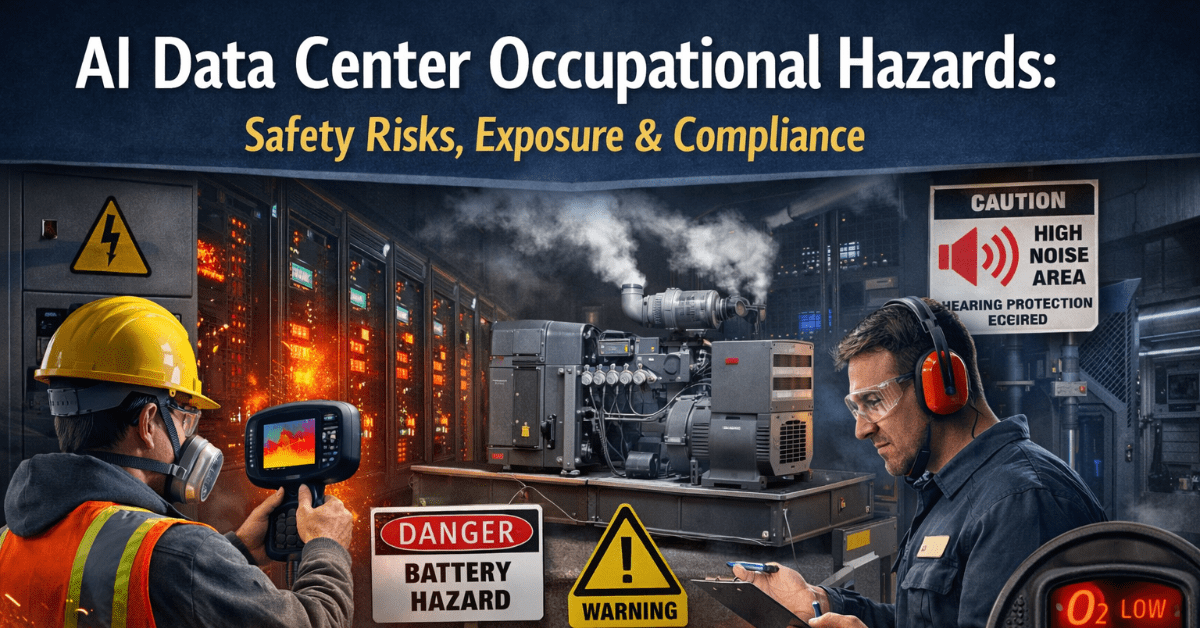
Key Occupational Hazards in AI Data Centers: From Thermal Stress to Electromagnetic Exposure
Artificial intelligence (AI) data centers are rapidly transforming the backbone of global digital infrastructure. As AI computing demand accelerates, facilities are expanding in scale, density, and energy consumption. While these environments are engineered for uptime and performance, AI data center occupational hazards are becoming more complex as operational intensity increases.
Unlike traditional IT facilities, AI-driven environments operate with extreme thermal loads, high electrical demand, advanced cooling systems, on-site backup power generation, battery energy storage systems, and continuous construction or expansion cycles. These conditions create a dynamic exposure profile requiring structured environmental health and safety (EHS) oversight and ongoing industrial hygiene monitoring.
Understanding and proactively managing AI data center occupational hazards is essential to protecting workers, ensuring regulatory compliance, and maintaining operational continuity.
Why AI Data Center Occupational Hazards Require Continuous Oversight
AI data centers combine elements of power generation plants, mechanical facilities, high-density computing environments, and active construction zones. This overlap introduces cumulative safety risks that evolve as infrastructure scales.
Primary drivers of occupational risk in AI infrastructure include:
High-density computing generating extreme heat
Continuous mechanical and cooling system operation
On-site diesel backup generation
Battery energy storage systems
Live electrical distribution networks
Ongoing retrofits and expansion projects
Because AI infrastructure rarely remains static, hazard identification must be ongoing rather than reactive. This reinforces the importance of independent EHS evaluations in identifying emerging AI data center safety risks before they escalate into compliance violations or workplace incidents.
Thermal Stress and Heat Exposure in AI Data Centers
Thermal stress is one of the most significant AI data center occupational hazards. High-performance computing clusters generate substantial heat, and even advanced cooling strategies can produce localized hot zones.
Personnel performing inspections, maintenance, or emergency response may experience elevated ambient temperatures, radiant heat exposure, and restricted airflow.
Common contributors to heat stress in AI data centers include:
Temporary cooling disruptions during service
High-density server racks
Hot aisle containment systems
Mechanical and electrical rooms
Rooftop cooling infrastructure
Heat-related illness can include dehydration, heat exhaustion, and heat stroke, particularly during extended work periods.
Noise Exposure from Cooling and Mechanical Systems
AI data center safety must also account for continuous mechanical noise exposure. Cooling systems, generators, air handlers, and electrical infrastructure can generate sustained sound levels requiring evaluation under occupational standards.
Electromagnetic Fields (EMF) and Electrical Hazards
Electrical systems supporting AI workloads operate at high capacity and complexity. Workers near transformers, switchgear, bus ducts, and power distribution units face potential exposure to electromagnetic fields and electrical hazards.
Key electrical risks include:
Arc flash incidents
Shock exposure
Thermal burns
Equipment failure during energized maintenance
Although EMF exposure in data centers is typically below regulatory limits, exposure evaluation is essential as infrastructure density increases. Electrical hazard management should align with OSHA electrical safety standards and broader AI data center safety compliance protocols.
These compliance considerations connect directly to AI Data Center Safety Compliance in 2026, particularly as AI infrastructure grows more power-intensive.
Diesel Exhaust and Combustion Byproducts
Backup diesel generators are critical for maintaining uptime during outages and grid instability. However, combustion byproducts introduce measurable occupational health risks.
Diesel exhaust in data centers may contain:
Diesel particulate matter (DPM)
Nitrogen oxides
Carbon monoxide
Volatile organic compounds (VOCs)
Exposure risk increases during testing cycles, maintenance procedures, and ventilation malfunctions. Diesel exhaust is classified as a carcinogenic exposure, making air monitoring and ventilation performance assessments essential components of EHS for AI data centers.
Battery energy storage safety in AI data centers presents unique chemical and thermal hazards. Lithium-ion and other advanced battery technologies introduce risks related to off-gassing, fire, and confined atmospheres.
Potential risks include:
Off-gassing of flammable or toxic gases
Thermal runaway events
Corrosive byproducts
Oxygen displacement in enclosed battery rooms
Battery areas require:
Engineered ventilation systems
Gas detection monitoring
Emergency response planning
Routine industrial hygiene evaluations
Safety practices are informed byNFPA energy storage system standards, which establish requirements for hazard mitigation and emergency response procedures.
Construction, Expansion, and Retrofit Hazards
AI data centers frequently undergo infrastructure expansion to support growing computational demand. Construction activities occurring alongside live operations introduce additional exposure risks.
Common construction-related hazards include:
Silica dust from cutting and drilling
Welding fumes
Elevated noise and vibration
Diesel exhaust from equipment
Electrical hazards during system tie-ins
Confined space risks
These exposures must be managed without disrupting active facility operations. Coordinated safety planning and independent oversight are essential in these environments.
These evolving risks align with broader compliance considerations discussed in AI Data Center Safety Compliance in 2026.
Confined Space and Ventilation Hazards
Subfloor plenums, electrical vaults, mechanical pits, and cooling enclosures may present confined space hazards.
Risks may include:
Oxygen deficiency
Heat accumulation
Chemical vapor buildup
Restricted emergency egress
Confined space evaluation and atmospheric monitoring are critical to controlling AI data center occupational hazards in enclosed environments.
Ergonomic and Fatigue Risks
Data center worker safety risks extend beyond chemical and physical exposures. Ergonomic strain and fatigue contribute to musculoskeletal injury and reduced alertness.
Common ergonomic risk factors include:
Lifting heavy equipment components
Awkward postures in server aisles
Prolonged standing
Repetitive cable management tasks
Addressing ergonomic hazards strengthens overall AI data center safety performance and reduces injury-related downtime.
Why Ongoing Hazard Monitoring Is Essential
AI data center occupational hazards are dynamic. As infrastructure density increases and technologies evolve, new exposure risks emerge.
The Role of Independent Industrial Hygiene in AI Data Centers
Independent industrial hygiene professionals provide objective exposure assessments tailored to complex computing environments.
Services commonly include:
Heat stress monitoring
Noise dosimetry
Air contaminant sampling
Diesel particulate monitoring
Ventilation evaluations
Confined space assessments
Independent EHS evaluations strengthen compliance posture and support proactive management of AI data center occupational hazards.
How Phase Associates Supports AI Data Center Safety
Phase Associates delivers specialized environmental health and safety (EHS) and industrial hygiene services for AI data centers nationwide. From exposure monitoring and compliance alignment to independent EHS evaluations, Phase Associates supports organizations managing complex AI infrastructure and evolving AI data center occupational risks.
With experience supporting high-density computing facilities, energy systems, and advanced industrial operations across the United States, Phase Associates provides science-based assessments grounded in OSHA regulations and industry standards.
Industrial hygiene testing, OSHA safety training, and compliance services are delivered nationwide, supported by established offices in New Jersey (Atlantic City), New York City, Pennsylvania (Philadelphia and Pittsburgh), Georgia (Atlanta), Maryland (Baltimore and Washington, DC area), Massachusetts (Boston), Michigan (Detroit), Arkansas (Bentonville), and surrounding regions.
Strengthen Your AI Data Center Safety Program
AI data centers require advanced safety oversight due to their energy density, infrastructure complexity, and continuous expansion. Proactively addressing AI data center occupational hazards through independent evaluation and industrial hygiene monitoring helps protect workers, maintain regulatory compliance, and safeguard critical infrastructure uptime.
To strengthen your AI data center safety program through independent EHS and industrial hygiene evaluation, contact Phase Associatesto schedule a consultation and ensure your facility remains safe, compliant, and resilient as AI infrastructure continues to grow.
AI Infrastructure Growth Is Reshaping the Data Center Landscape
Artificial intelligence is fundamentally changing how data centers are designed, built, and operated. As organizations deploy AI at scale, data center infrastructure is expanding rapidly to support higher computing density, increased power demand, and advanced cooling technologies. These facilities now operate more like high-intensity industrial environments than traditional IT spaces.
With this transformation comes a new class of environmental, health, and safety risks. Internal safety programs alone are often not sufficient to keep pace with the complexity of AI-driven operations. Independent, third-party EHS evaluations provide an objective layer of oversight that helps organizations identify emerging risks, validate controls, and maintain regulatory confidence as infrastructure grows.
Why AI Data Centers Require a Different EHS Approach
AI workloads place extraordinary demands on physical infrastructure. Power densities are significantly higher, electrical systems are more complex, and cooling strategies often involve liquid-based technologies alongside traditional air systems. These conditions introduce hazards that differ from those found in legacy data centers.
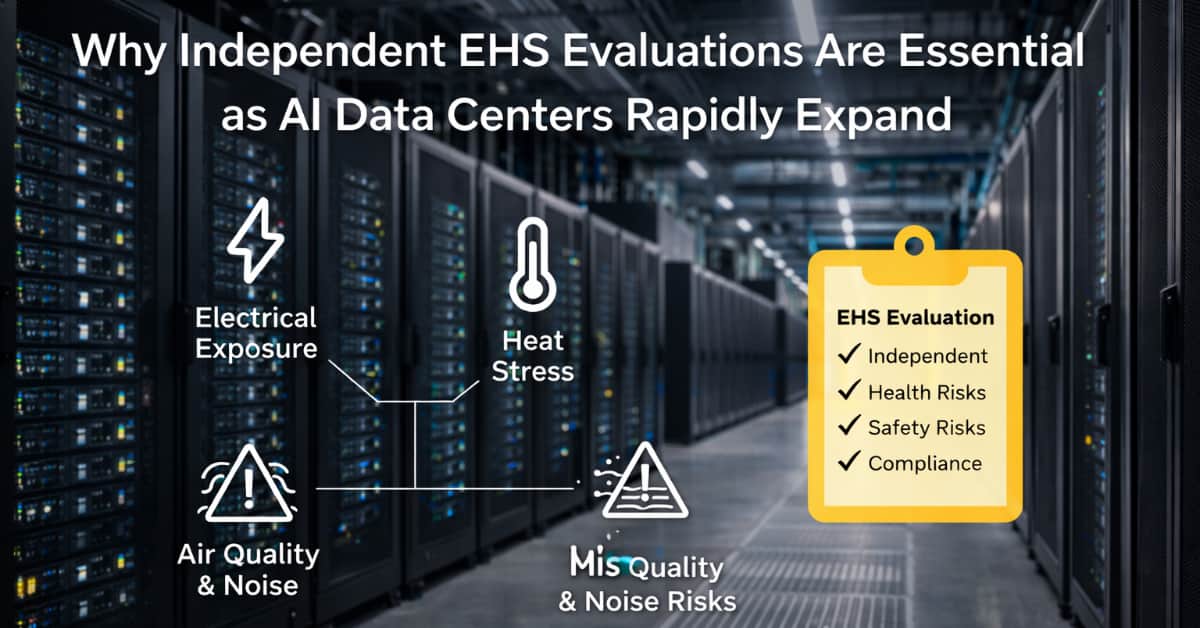
Electrical exposure risks increase as facilities scale. Thermal stress becomes more pronounced when cooling systems operate at maximum capacity. Noise levels rise as mechanical systems run continuously. Chemical and air quality considerations emerge from battery storage, fire suppression agents, and backup generation systems. Each of these risks must be evaluated within the context of a live, mission-critical environment.
Third-party EHS evaluations are uniquely suited to assess these risks holistically, rather than focusing on isolated compliance checklists or internal assumptions.
As AI data centers increasingly resemble industrial environments, understanding how safety and health risks evolve alongside infrastructure becomes essential. This broader risk landscape is explored further in AI Data Centers: Safety, Health Risks & Evaluation Standards, which examines how modern facilities introduce new exposure and compliance challenges.
The Value of Third-Party EHS Evaluations
Independent EHS evaluations bring objectivity that internal teams may not be able to achieve. As organizations invest heavily in AI infrastructure, internal stakeholders can become closely tied to operational decisions, timelines, and budgets. Third-party evaluators provide unbiased insight into how safety, health, and environmental risks are being managed.
This independence is crucial for organizations operating multiple data centers or planning rapid expansion. Consistent evaluation standards across sites help leadership identify systemic risks, benchmark performance, and prioritize mitigation efforts. Third-party assessments also support transparency when communicating with regulators, insurers, investors, and partners.
Addressing Safety Risks in High-Density AI Environments
Safety risks in AI data centers extend beyond traditional electrical and mechanical hazards. High-capacity power distribution systems increase arc flash potential. Dense rack configurations limit physical access during maintenance and emergency response. Cooling failures can escalate quickly, creating unsafe working conditions.
Third-party EHS evaluations examine how these risks interact under real operating conditions. Rather than relying solely on design assumptions, evaluators assess how systems perform during peak loads, maintenance activities, and abnormal events. This approach helps organizations identify vulnerabilities before incidents occur.
Occupational Health Considerations in AI Data Centers
Occupational health risks are often less visible but equally critical. Continuous exposure to elevated noise levels from cooling equipment and generators can impact worker health over time. Thermal stress may affect personnel performing extended tasks in equipment aisles or mechanical rooms.
Indoor air quality is another growing concern. AI data centers may house battery energy storage systems, cooling fluids, and combustion-based backup power, all of which can influence airborne contaminant levels. Third-party industrial hygiene assessments help quantify these exposures and guide appropriate controls.
As AI data center footprints expand, environmental considerations become more complex. Backup generators, cooling water usage, chemical storage, and waste heat emissions can trigger permitting and reporting obligations at local, state, and federal levels.
Third-party EHS evaluations help organizations understand how infrastructure growth affects environmental compliance. Evaluators review operational practices, emissions controls, and monitoring programs to ensure alignment with evolving regulations. This proactive approach reduces the likelihood of enforcement actions and supports responsible growth.
Facilities operating in major technology corridors, dense urban regions, or environmentally sensitive areas often face heightened scrutiny, making independent evaluation especially valuable.
Integrating EHS Into Infrastructure Planning
One of the most significant advantages of third-party EHS evaluations is their ability to inform future planning. AI data center growth rarely happens all at once. Expansions occur in phases, with incremental increases in power, cooling, and computing capacity.
Independent evaluations help organizations anticipate how these changes will alter risk conditions. Findings can influence equipment selection, layout decisions, maintenance strategies, and emergency preparedness planning. By integrating EHS considerations early, organizations reduce the need for costly retrofits and reactive controls later.
Emergency Preparedness and Resilience
AI data centers support mission-critical operations, making resilience a top priority. Electrical failures, cooling disruptions, fires, or hazardous material releases can have cascading effects if not managed effectively.
Third-party EHS evaluations assess emergency preparedness from a systems perspective. This includes reviewing emergency action plans, shutdown procedures, evacuation routes, and coordination with local responders. Scenario-based analysis helps organizations test assumptions and strengthen response capabilities before real-world incidents occur.
Supporting Workforce Safety Through Independent Oversight
As AI data centers expand, workforces often grow alongside them. Contractors, engineers, technicians, and operations staff interact with increasingly complex systems. Independent EHS evaluations help ensure training programs and safety procedures remain aligned with actual risks.
Rather than relying on generic training models, third-party evaluators identify site-specific hazards and recommend targeted improvements. This approach supports safer work practices and reinforces a culture of accountability across the organization.
Why Now Is the Time for Third-Party Evaluations
AI infrastructure growth is accelerating, not slowing down. Organizations that delay independent EHS evaluations risk falling behind as operational complexity increases. Waiting until incidents occur or regulators intervene can result in costly disruptions and reputational damage.
Third-party EHS evaluations provide a proactive path forward. They help organizations manage risk, document due diligence, and adapt to the evolving demands of AI-driven operations. As data centers continue to transition into industrial-scale facilities, independent oversight becomes a critical component of sustainable growth.
Phase Associates provides third-party Environmental Health and Safety evaluations customized to the realities of modern AI data center operations. With deep expertise in EHS consulting, industrial hygiene, and regulatory compliance, Phase Associates supports organizations navigating the challenges of infrastructure expansion.
By delivering objective, site-specific evaluations, Phase Associates helps data center owners and operators identify risks early, strengthen controls, and maintain confidence as AI infrastructure continues to scale.
As AI data center infrastructure grows in size and complexity, independent EHS evaluations are no longer optional. Contact Phase Associatestoday to schedule a third-party AI data center EHS evaluation designed to support safety, compliance, and long-term operational resilience.
AI Data Centers: Safety & Health Evaluations Every Facility Needs
Artificial intelligence (AI) is transforming nearly every industry, and with this transformation comes an explosive expansion of AI-powered data centers. These facilities operate at extremely high densities, running powerful Graphics Processing Unit (GPU) clusters that demand heavy cooling, significant electrical infrastructure, and strict environmental controls.
As AI workloads continue to rise, data centers face new and intensified occupational health and environmental safety risks. This is where Phase Associates, a leader in environmental health and safety consulting, becomes essential. Their comprehensive EHS evaluations, industrial hygiene monitoring, and professional safety training help AI data centers meet regulatory requirements while protecting workers and contractors.
Below is a complete guide to the critical safety and health evaluations AI data centers must conduct—from heat load and battery rooms to air quality, noise, ergonomics, and emergency preparedness.
The Rapid Growth of AI Data Centers—and the Safety Risks That Follow
AI servers produce far more heat than typical CPU-based data centers. With enormous GPU clusters, increasing rack densities, and accelerated construction timelines, safety issues can escalate quickly if not monitored.
Chemical exposures from cleaning agents and fire suppression
To maintain operational reliability and OSHA compliance, AI data centers must undergo specialized EHS evaluations—the kind Phase Associates performs nationwide.
Critical Safety & Health Evaluations for AI Data Centers
1. Air Quality & Ventilation Assessments
AI workloads mean more heat—more heat means higher cooling demand, more airflow, and more potential contaminant movement.
This ensures long-term compliance and reduces incident risk.
Why AI Data Centers Need Third-Party EHS Evaluations
Third-party evaluations are essential because they provide:
Objective, unbiased assessments
Expertise in high-tech facility hazards
Compliance guidance
Detailed written reports with actionable steps
On-site exposure monitoring with professional instrumentation
For AI data centers experiencing rapid growth, Phase Associates fills the expertise gap with industrial hygienists, EHS consultants, and trainers who understand complex infrastructure.
Benefits of Partnering With Phase Associates
Phase Associates provides:
Comprehensive EHS evaluations tailored to AI infrastructure
Exposure assessments, including noise, heat, and air quality
Industrial hygiene monitoring using NIOSH/OSHA sampling methods
OSHA compliance and training
Professional EHS outsourcing for ongoing site support
Emergency response and incident investigation assistance
AI data centers evolve rapidly—so must their safety programs.
Get Expert EHS Support for AI Data Centers
AI data centers are the backbone of modern technology—but they come with unique safety, environmental, and occupational health challenges. Proper evaluations protect workers, ensure compliance, maintain uptime, and prevent costly incidents.
Phase Associates is fully equipped to provide the specialized EHS expertise AI data centers require.