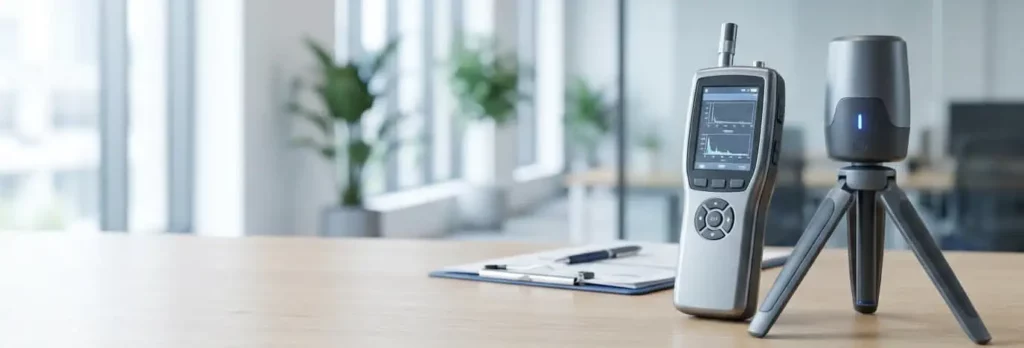
PHASE Associates knows that managing air quality is essential because it prevents illness and injury and provides a safe environment. Our professional team of Industrial Hygienists, Certified Industrial Hygienists (CIH’s), or Certified Microbial Consultants (CMC’s), and NY State Licensed Mold Assessor will implement indoor air quality testing, inspections, monitoring, assessments and recommendations for corrective actions. We use the latest direct-reading instruments and accredited laboratories using government-approved laboratory test methods when collecting samples.
The scope of an indoor air quality testing (IAQ) survey typically involves a visual inspection, occupant interviews and sampling of the subject building’s temperature, humidity, carbon dioxide, carbon monoxide and volatile organic compounds (VOCs).
Asbestos, Mold, Legionella, Radon, and Formaldehyde can be dangerous Indoor Air quality hazards and can be harmful to the workplace environment and one’s health. Our highly trained, board accredited professionals are able to conduct assessments, surveys and recommendations for the following services below.
Our EPA-certified AHERA inspectors will conduct a visual inspection and collect bulk samples for suspect Asbestos Containing Material (ACM), documenting, labeling and assessing each ACM. Asbestos services include indoor air quality testing, surveys, sampling, air monitoring and consulting.
All samples collected are analyzed by an accredited laboratory and handled under a strict quality control program to assure the safety of our clients and the integrity of our services.
To evaluate and reduce the risk of Legionella growth and exposure, an industrial hygienist will perform a systematic review of the building’s potable and non-potable water systems in alignment with applicable guidance in the OSHA Technical Manual.
This process is designed to identify system conditions that can contribute to bacterial amplification—such as stagnation, inadequate temperature control, and low-use piping—and then confirm that corrective actions are effective. The assessment will begin with an on-site walkthrough to document system components, operating conditions, and potential risk factors, followed by an evaluation of findings to determine the appropriate next steps. Based on the results, the hygienist will recommend practical control measures (e.g., maintaining proper system temperatures and eliminating dead legs) and, once those measures have been implemented successfully, will collect water samples to verify post-correction Legionella levels.
Our indoor air quality testing specialist will visit, assess the potentially hazardous conditions, collect airborne formaldehyde vapors as necessary, interpret and discuss the results for necessary ways to reduce exposure.
Formaldehyde is a colorless, strong-smelling gas that is highly reactive at a room temperature and is a common indoor pollutant. Formaldehyde is released into the home from variety of sources including wood burning, and cooking. Many wooden products such as plywood, pressed wood, and composite wood flooring use formaldehyde-based resins and glues. Eco-friendly wooden products, including wood flooring, cabinets, etc., may have been manufactured using formaldehyde-based resin as an adhesive as well.
Exposure to elevated levels of formaldehyde may cause a burning sensation in the eyes, skin rash, nose, and throat irritation. It also may lead to respiratory problems such as coughing, and asthma-like symptoms. Other exposure symptoms include headache, nausea, and fatigue. Formaldehyde is classified as a human carcinogen.
Our highly trained industrial hygienists, Certified Industrial Hygienists (CIH) or Certified Microbial Consultants (CMC) will conduct the inspections and surveys and will also provide recommendations and/or create a bioremediation plan.
Our indoor air quality testing provides pre-remediation and post-remediation surveys and has worked with insurance companies and remediation companies as an unbiased third-party contractor.
We can serve New York City and New York State as PHASE Associates obtained a New York State Mold Assessor license. We have qualified NY Mold Assessors who have been licensed by the New York State Department of Labor.
Currently, all of our indoor air quality testing mold investigations follow the ASTM E 2418-06 guidelines for assessing readily observable mold, as well as determining conditions and physical deficiencies conducive to mold. All recommendations derived from our inspections are in accordance with accepted guidelines determined by the EPA as well as the American Conference of Industrial Hygienists (ACGIH).
PHASE Associates has a niche in conducting radon surveys for child care centers. Every five years, child care centers need to conduct a radon survey in order to renew their license. By law, only the building owner or a NJ Certified radon business can conduct the radon survey for child care centers.
All radon testing is done by our radon professional, a licensed New Jersey Radon Measurement Specialist (RMS). Our radon surveys extend to child care centers, homes and commercial buildings.
The process is to collect, deploy and pick up the measurement radon devices. Each radon canister will be left for four days. No windows or doors can be left open during that period of time unless for normal exit and entry.
Our experienced indoor air quality testing Industrial Hygienists will provide the necessary support to protect personnel against respirable crystalline silica inhalation hazards. We develop and implement engineering controls and work practices; provide training and conduct air measurement sampling and silica dust surveys.
Close to 2.3 million individuals are exposed to respirable crystalline silica in construction and general industries. Exposure occurs during specific work-related tasks that create respirable silica dust, very small crystalline silica particles, that are inhaled. To provide a comparison, respirable crystalline silica is at least 100 times smaller than sand particles found on beaches.
Over a period of time, exposure is harmful and possibly lethal. Respirable crystalline silica exposure can significantly increase the risk of cancer, silicosis, chronic obstructive pulmonary disease, and kidney disease. To better protect works, The Occupational Safety and Health Administration (OSHA), on March 25, 2016, finalized two new silica standards, one for general industry, maritime and for construction.
“As a facility operations manager in the environmental services sector, I can confidently say that Phase Associates delivered exceptional HAZWOPER training to our workforce. The course was expertly structured, highly engaging, and easy to comprehend—even for team members new to hazardous site protocols. Most importantly, it provided the depth and clarity needed to ensure our compliance and readiness in high-risk environments. Our team now feels fully equipped to handle hazardous materials situations safely and effectively.”
Brandon J
“Phase Associates has been an outstanding partner in elevating our respiratory protection program. Their on-site respirator fit testing was conducted efficiently and with expert attention to detail, ensuring compliance across multiple departments. In addition to testing, they provided valuable guidance on PPE selection, training, and documentation protocols that helped us streamline our safety procedures. Their team is knowledgeable, responsive, and truly understands the needs of industrial environments.”
Thomas P
“After receiving an unexpected OSHA citation, we contacted Phase Associates for help—and it was the best decision we made. Their industrial hygiene team responded immediately, conducted comprehensive air monitoring and a full noise survey, and explained every step in terms we could actually understand. They not only identified the issues contributing to our citation but also provided practical, actionable solutions that helped us get back into compliance quickly. Thanks to their expertise, we now have stronger safety processes in place and far more confidence in our work environment.”
Philip H
“Phase Associates provided exceptional Construction Safety Officer support on our project. Their deep knowledge of OSHA standards and construction safety regulations was evident from day one. They not only identified issues before they became problems but also communicated clearly with our management team, ensuring everyone understood the ‘why’ behind each recommendation. Their guidance kept our project running safely, smoothly, and fully compliant.”
Mike L
Typically when there are persistent odors, occupant symptoms (headaches, irritation, respiratory issues), visible mold/water damage, HVAC/ventilation complaints, after a renovation, or when a building experienced a moisture event.
IAQ testing can identify building conditions like temperature, humidity, and ventilation, and may include monitoring/testing for carbon dioxide (CO₂), carbon monoxide (CO), volatile organic compounds (VOCs), mold/bioaerosols, asbestos, radon, odors, and Legionella depending on the concern.
The “right” targets depend on the complaint, but frequent culprits include VOC sources, combustion byproducts (CO/CO₂ issues tied to ventilation), moisture-related mold/bacteria, and building-specific risks like asbestos, radon, formaldehyde, or Legionella.
Many IAQ assessments can be performed with minimal disruption (walkthrough + measurements/sampling). The total timeline depends on building size, number of areas sampled, and lab turnaround if samples are collected.
IAQ testing is strong at identifying and quantifying potential exposures and conditions (like ventilation issues, elevated VOCs, mold indicators, etc.), but health symptoms require consulting with a healthcare professional. The best outcomes come from pairing data with a building walkthrough, HVAC review, and occupant/operations context.
Most clients want a clear deliverable: a summary of findings, the measurements/lab results, and practical recommendations (for example: ventilation adjustments, moisture corrections, source removal, cleaning/maintenance actions, or additional targeted testing).