As AI infrastructure continues to expand across the United States, operators are facing increased scrutiny around workplace safety, compliance, and operational risk management. Preparing for an AI data center safety audit is no longer something organizations can treat as an occasional task—it has become a critical part of maintaining compliant and scalable operations.
AI facilities operate in high-demand environments that involve elevated electrical loads, advanced cooling systems, noise exposure, heat stress risks, and complex infrastructure. These conditions create unique challenges that require a structured and proactive compliance strategy.
Organizations that fail to properly prepare for an AI data center safety audit may face regulatory penalties, operational disruptions, increased liability exposure, and long-term reputational damage.
As outlined in AI Data Center Safety Compliance in 2026, regulatory expectations surrounding AI infrastructure continue to evolve as facilities become larger and more operationally complex.
Why AI Data Center Safety Audits Are Becoming More Important
Safety audits are designed to evaluate whether a facility is operating in accordance with workplace safety regulations, industrial hygiene standards, and internal compliance programs.
For AI facilities, audits often focus on:
Workplace hazard identification
Employee training records
Industrial hygiene monitoring
Electrical safety procedures
Emergency response preparedness
Documentation and compliance reporting
A well-executed audit process helps organizations identify weaknesses before they become major incidents.
The growing importance of the AI data center safety audit process is tied directly to the rapid expansion of hyperscale AI operations, where operational failures can carry significant financial and safety consequences.
Understanding What Auditors Typically Review
Before organizations can properly prepare for an AI data center safety audit, they must understand what auditors are likely to examine.
Common Audit Focus Areas
OSHA compliance programs
Written safety procedures
Hazard communication programs
Lockout/tagout (LOTO) compliance
Employee safety training records
Incident reporting systems
Air quality and industrial hygiene data
Equipment maintenance records
Emergency evacuation procedures
Facilities that maintain organized documentation and consistent compliance programs are generally better positioned during audits.
Organizations should also stay aligned with standards and guidance from the Occupational Safety and Health Administration, especially as enforcement efforts continue to evolve in high-risk environments.
Start with a Full Internal Compliance Review
One of the most effective ways to prepare for an AI data center safety audit is to conduct a full internal review before the official audit occurs.
This process helps identify gaps in compliance, outdated procedures, and missing documentation.
Internal Review Priorities
Review all safety programs and SOPs
Verify employee training completion
Confirm industrial hygiene monitoring schedules
Evaluate emergency response readiness
Inspect equipment maintenance logs
Internal reviews provide organizations with an opportunity to correct issues proactively instead of reacting during an actual audit.
Verify Industrial Hygiene Monitoring Programs
Industrial hygiene is one of the most important components of any AI data center safety audit because it directly addresses workplace exposure risks.
Facilities should ensure they are actively monitoring:
Noise exposure levels
Heat stress conditions
Indoor air quality
Chemical exposure risks
Electromagnetic field (EMF) concerns where applicable
Many organizations fail audits because monitoring data is incomplete, outdated, or inconsistently documented.
For additional guidance, refer to What to Measure and Monitor in AI Data Center Industrial Hygiene Programs.
Review Employee Safety Training Records
Training deficiencies are one of the most common compliance problems identified during audits.
To properly prepare for an AI data center safety audit, organizations should verify that all required training is current and fully documented.
Training Areas Commonly Reviewed
Hazard communication (HazCom)
Electrical safety procedures
Lockout/tagout training
Emergency response protocols
PPE usage and awareness
Heat stress and environmental hazards
Training records should include:
Completion dates
Attendance logs
Refresher schedules
Instructor information
Well-organized training documentation demonstrates strong compliance management practices.
Evaluate Workplace Hazard Controls
Auditors will often assess how effectively organizations identify and control workplace hazards.
This includes reviewing:
Physical safeguards
Engineering controls
Administrative procedures
PPE requirements
Incident prevention strategies
Organizations should ensure that workplace hazards are clearly documented and addressed through established procedures.
One of the fastest ways to create problems during an AI data center safety audit is disorganized documentation.
Auditors typically expect quick access to:
Safety policies
Inspection records
Incident reports
Monitoring data
Maintenance logs
Compliance certifications
Facilities that rely on outdated filing systems or inconsistent reporting processes often struggle during compliance reviews.
Documentation Best Practices
Centralize digital records
Maintain standardized reporting formats
Schedule regular document reviews
Archive outdated materials properly
Strong documentation systems improve both compliance and operational efficiency.
Review Emergency Preparedness Procedures
Emergency preparedness is another critical area in any AI data center safety audit.
Facilities should review:
Emergency evacuation plans
Fire response procedures
Spill response protocols
Backup communication systems
Incident escalation procedures
Organizations operating high-density AI infrastructure must ensure employees understand how to respond during emergencies involving electrical systems, overheating events, or equipment failures.
Conduct Facility Walkthroughs Before the Audit
Pre-audit walkthroughs help identify visible safety concerns before auditors arrive on-site.
Common Issues Found During Walkthroughs
Blocked exits or pathways
Improper PPE usage
Missing signage
Poor housekeeping practices
Unlabeled hazards
Damaged equipment
These walkthroughs provide an opportunity to resolve problems quickly and improve overall audit readiness.
Preparing for an AI data center safety audit involves multiple layers of compliance review, operational planning, and workplace safety management. Organizations that proactively evaluate these areas are often better positioned to identify gaps early, improve documentation accuracy, and strengthen overall audit readiness across AI infrastructure environment
A structured audit readiness strategy helps organizations maintain stronger consistency across training, industrial hygiene monitoring, hazard controls, and compliance documentation. As AI data center operations continue to scale, proactive EHS planning remains essential for reducing risk, improving operational performance, and supporting long-term regulatory compliance.
Standardize Multi-Site Compliance Programs
Organizations operating across multiple facilities face additional challenges when preparing for an AI data center safety audit.
Inconsistent procedures between locations often create major compliance gaps.
Multi-Site Readiness Strategies
Standardize safety programs
Use centralized reporting systems
Align training across facilities
Conduct regular cross-site audits
Maintain unified documentation standards
Consistency is critical for organizations scaling AI infrastructure nationally.
Work with Experienced EHS Professionals
Preparing for a complex compliance audit often requires outside expertise.
Experienced EHS consultants can help organizations:
Identify compliance gaps
Conduct mock audits
Improve documentation systems
Develop corrective action plans
Strengthen industrial hygiene programs
Facilities with proactive EHS support are typically better prepared for regulatory reviews and operational inspections.
We support AI data center operators nationwide, including NJ (Atlantic City), NYC, PA (Philadelphia, Pittsburgh), GA (Atlanta), MD (Baltimore & DC Area), MA (Boston), MI (Detroit), Arkansas (Bentonville), and surrounding regions.
Our team helps organizations prepare for an AI data center safety audit through structured compliance reviews, industrial hygiene assessments, and scalable EHS support programs.
Strengthen Your AI Data Center Audit Readiness
Successfully preparing for an AI data center safety audit requires more than basic documentation—it requires a proactive strategy built around compliance, operational safety, and long-term risk management.
Phase Associates works with AI data center operators to evaluate existing programs, identify compliance gaps, and improve audit readiness across complex facilities and multi-site operations.
From industrial hygiene testing to OSHA training and comprehensive EHS consulting, we help organizations build safer, more compliant environments.
Contact Phase Associates today to improve your audit readiness strategy and strengthen compliance across your AI data center operations.
AI data centers are expanding rapidly across the United States, but with that growth comes a major shift in operational responsibility. The cost of EHS compliance for AI data centers is no longer a secondary consideration—it’s a core part of infrastructure planning, risk management, and long-term performance.
Unlike traditional facilities, AI environments introduce higher energy demands, complex cooling systems, and increased exposure to occupational hazards. These factors directly impact the EHS compliance cost for AI data centers, requiring more advanced monitoring, training, and program development.
As outlined in AI Data Center Safety Compliance in 2026, regulatory expectations and enforcement trends are evolving quickly, making proactive compliance more important than ever.
Why AI Data Centers Face Higher EHS Costs
The rise in AI data center EHS costs is driven by both operational complexity and regulatory pressure. Facilities must now account for a broader range of risks while maintaining continuous uptime.
These factors contribute directly to the rising cost of EHS compliance for AI data centers, especially as facilities scale.
Core Components That Make Up EHS Compliance Costs
To understand how budgets are built, it’s important to break down the primary areas that influence AI data center EHS costs.
The cost of EHS compliance for AI data centers is influenced by several core operational areas. From industrial hygiene monitoring and workforce training to documentation systems and multi-site compliance management, each component plays a role in maintaining safe, compliant, and scalable AI infrastructure environments.
Organizations that invest in these foundational EHS components are often better positioned to reduce operational risk, strengthen compliance performance, and improve long-term safety management across AI data center operations.
Industrial Hygiene Testing and Monitoring
Industrial hygiene plays a central role in determining the EHS compliance cost for AI data centers. It focuses on identifying and controlling workplace hazards before they lead to incidents.
Training is a required and ongoing investment that directly impacts the cost of EHS compliance for AI data centers.
Programs typically include:
Hazard communication (HazCom)
Lockout/tagout procedures
Electrical safety training
Heat stress awareness
Emergency response protocols
Estimated cost ranges:
$100 – $500 per employee
$5,000 – $30,000+ annually for full programs
EHS Program Development and Documentation
A complete compliance strategy requires structured documentation and standardized procedures. This is a foundational component of AI data center EHS costs.
Programs typically include:
Written safety plans
Standard operating procedures (SOPs)
Incident tracking systems
Compliance documentation
Estimated cost ranges:
Initial development: $10,000 – $40,000+
Annual updates: $5,000 – $15,000
Multi-Site EHS Management
Many AI operators manage multiple facilities, which increases the overall EHS compliance cost for AI data centers.
Challenges include:
Maintaining consistency across locations
Adapting to state-specific regulations
Coordinating training and monitoring programs
Centralizing compliance reporting
Estimated cost ranges:
$25,000 – $100,000+ annually depending on scale
In-House vs Outsourced EHS: Cost Comparison
One of the biggest factors affecting the cost of EHS compliance for AI data centers is how programs are managed.
In-House EHS Teams
Salaries: $90,000 – $140,000+ per manager
Additional staff and specialists
Equipment and software investments
Ongoing certification and training
Outsourced EHS Support
Scalable service model
Access to specialized expertise
Reduced overhead and staffing costs
Faster implementation across multiple sites
For organizations expanding quickly, outsourcing often reduces the total EHS compliance cost for AI data centers while improving program efficiency.
Hidden Costs of Poor Compliance
Failing to properly manage EHS programs can significantly increase the cost of EHS compliance for AI data centers over time.
Accurate budgeting requires a full understanding of both direct and indirect costs.
Typical Annual Budget Ranges
Small facilities: $25,000 – $75,000
Mid-size operations: $75,000 – $200,000
Large/hyperscale: $200,000 – $500,000+
These estimates reflect the general EHS compliance cost for AI data centers when programs are properly implemented.
How to Reduce EHS Costs Without Increasing Risk
Reducing costs should never mean cutting safety measures. Instead, organizations should focus on efficiency and scalability.
Effective strategies include:
Standardizing compliance programs across locations
Scheduling data-driven monitoring
Investing in preventative training
Leveraging experienced EHS consultants
Integrating compliance into operational workflows
These approaches help manage the cost of EHS compliance for AI data centers while maintaining full regulatory alignment.
National EHS Support for AI Data Centers
Phase Associates provides industrial hygiene testing, OSHA safety and compliance training, and professional EHS outsourcing services across the United States.
We support AI data center operators nationwide, including NJ (Atlantic City), NYC, PA (Philadelphia, Pittsburgh), GA (Atlanta), MD (Baltimore & DC Area), MA (Boston), MI (Detroit), Arkansas (Bentonville), and surrounding areas.
Build a Smarter EHS Strategy for Your AI Data Center
Understanding the cost of EHS compliance for AI data centers is the first step—implementing the right strategy is what protects your operations long-term.
Phase Associates works with AI data center operators to design scalable EHS programs that reduce risk, improve compliance, and control costs across single and multi-site environments.
Contact Phase Associates today to schedule an EHS assessment and develop a compliance strategy tailored to your AI facility.
Industrial Hygiene Testing for AI Data Centers: What to Measure, Monitor, and Document
AI data centers operate at a scale and energy density that introduce complex occupational health risks. As computing loads increase and facilities expand to support artificial intelligence infrastructure, the need for structured industrial hygiene testing for AI data centers becomes increasingly critical.
Unlike traditional commercial buildings, AI data centers combine high-density computing, large-scale cooling systems, battery energy storage, on-site diesel generation, and continuous infrastructure upgrades. These elements create layered exposure risks that require systematic evaluation, measurement, and documentation.
Industrial hygiene testing in AI data centers is not optional. It is foundational to regulatory compliance, workforce protection, operational continuity, and defensible risk management.
Why Industrial Hygiene Testing Is Essential in AI Data Centers
AI environments are dynamic. Power loads increase. Cooling systems intensify. Generator capacity expands. Construction overlaps with live operations. These conditions introduce evolving exposure risks that cannot be managed through assumptions alone.
Industrial hygiene testing for AI data centers provides:
Quantitative exposure data
Regulatory compliance validation
Early hazard detection
Documentation for Occupational Safety and Health Administration (OSHA) alignment
Objective evaluation through independent EHS evaluations
Without structured monitoring, exposure risks such as heat stress, noise, diesel exhaust, airborne contaminants, and confined space atmospheres may go undetected until incidents occur.
AI data center environments involve multiple occupational and environmental factors that require ongoing monitoring. Effective EHS programs go beyond routine inspections and focus on measurable conditions that can affect worker safety, operational reliability, and regulatory compliance. The visual guide below highlights several of the most important EHS monitoring categories found within modern AI data center environments.
A comprehensive monitoring strategy should combine industrial hygiene assessments, exposure evaluations, and routine safety reviews. Organizations that consistently track these areas often identify emerging risks earlier, strengthen compliance programs, and improve long-term operational safety as AI infrastructure continues to expand.
Heat Stress Monitoring in AI Data Centers
High-performance computing clusters generate extreme heat. Even advanced cooling systems can produce localized hot zones, especially during peak processing loads or maintenance scenarios.
Heat stress testing measures:
Wet Bulb Globe Temperature (WBGT)
Ambient air temperature
Radiant heat contribution
Humidity levels
Airflow effectiveness
Heat stress in AI data centers may increase during emergency repair events, cooling system failures, rooftop equipment maintenance, and mechanical room inspections.
Additional context on exposure assessment methods can be found in Industrial Hygiene in AI Data Centers.
Noise Dosimetry and Occupational Sound Monitoring
Cooling infrastructure, generators, transformers, and mechanical equipment can create continuous sound exposure levels. AI data center safety programs must evaluate whether sustained noise exceeds occupational thresholds.
Noise exposure testing includes:
Personal dosimetry monitoring
Area sound level measurements
Peak exposure evaluation
Time-weighted average calculations
High-risk areas typically include:
Central mechanical rooms
Generator enclosures
Cooling plant equipment
Electrical substations
Active construction zones
Noise dosimetry performed as part of Comprehensive EHS & Industrial Hygiene Assessments for AI Data Centers evaluates exposure levels relative to OSHA occupational noise exposure standardsand determines whether hearing conservation programs are required.
Air Monitoring for Diesel Exhaust and Combustion Byproducts
Backup diesel generation remains essential for AI data center reliability. However, diesel exhaust in data centers introduces measurable occupational health risks.
Industrial hygiene testing for AI data centers should include monitoring for:
Diesel particulate matter (DPM)
Nitrogen oxides
Carbon monoxide
Volatile organic compounds (VOCs)
Exposure risks increase during generator testing cycles, extended outage events, maintenance operations, and ventilation system malfunctions.
Battery Energy Storage Monitoring and Off-Gassing Detection
Battery energy storage systems introduce unique chemical and atmospheric hazards. Lithium-ion and similar technologies can produce off-gassing, thermal events, and oxygen displacement under certain conditions.
Routine industrial hygiene testing in battery rooms supports early hazard detection and emergency preparedness.
Electrical and Electromagnetic Exposure Assessment
Electrical infrastructure supporting AI computing loads operates at high capacity. Workers performing maintenance near switchgear, transformers, and bus ducts require evaluation of electrical hazards and electromagnetic exposure.
Assessment activities may include:
Arc flash risk documentation
EMF measurement
Electrical hazard evaluation
Lockout/tagout program review
Electrical hazard management should align with OSHA electrical safety standards and broader AI data center safety compliance requirements.
These considerations connect directly to AI Data Center Safety Compliance in 2026.
Silica, Welding Fumes, and Construction Exposure Testing
AI data centers are frequently under construction or expansion. Industrial hygiene testing during active projects is critical to managing contractor and employee exposure.
Construction-related testing may include:
Respirable crystalline silica sampling
Welding fume monitoring
Noise exposure evaluation
Diesel exhaust monitoring
Vibration assessment
Construction safety in AI data centers requires coordination between contractors, operations staff, and EHS professionals.
Confined Space Atmospheric Monitoring
Subfloor plenums, vaults, cooling pits, and enclosed mechanical spaces may present confined space hazards.
Testing should evaluate:
Oxygen concentration
Flammable gas presence
Toxic vapor buildup
Heat accumulation
Ventilation performance
Confined space monitoring protects both maintenance personnel and emergency responders.
What Should Be Documented in an AI Data Center Industrial Hygiene Program
Testing alone is not sufficient. Documentation is essential for compliance, defensibility, and operational continuity.
Frequency of Industrial Hygiene Testing in AI Data Centers
Industrial hygiene testing frequency depends on facility size, infrastructure changes, construction activity, power load increases, and regulatory requirements.
Reassessment is recommended following:
Major equipment upgrades
Cooling system modifications
Generator expansion
Battery system installation
Regulatory updates
Exposure complaints
Ongoing monitoring is more effective than one-time testing in dynamic AI environments.
The Role of Independent Industrial Hygiene Testing
Independent industrial hygiene testing provides objective, science-based exposure data that supports compliance and risk mitigation.
Independent oversight strengthens:
Regulatory defensibility
Worker confidence
Executive decision-making
Risk transparency
As AI data center occupational hazards increase in complexity, independent EHS evaluations ensure testing remains unbiased and credible.
How Phase Associates Supports Industrial Hygiene Testing for AI Data Centers
Phase Associates provides comprehensive industrial hygiene testing for AI data centers across the United States. Services include heat stress monitoring, noise dosimetry, diesel exhaust sampling, confined space evaluation, battery off-gassing detection, construction exposure monitoring, and compliance documentation.
With established offices in New Jersey (Atlantic City), New York City, Pennsylvania (Philadelphia and Pittsburgh), Georgia (Atlanta), Maryland (Baltimore and the Washington, DC area), Massachusetts (Boston), Michigan (Detroit), Arkansas (Bentonville), and surrounding regions, Phase Associates supports both regional facilities and multi-state AI data center operations.
Strengthen Your AI Data Center Industrial Hygiene Program
AI data centers operate in high-density, high-energy environments that demand proactive exposure monitoring. Industrial hygiene testing is essential to protecting workers, maintaining compliance, and ensuring uninterrupted infrastructure performance.
To implement structured industrial hygiene testing for AI data centers through independent evaluation, contact Phase Associates to schedule a consultation and ensure your AI infrastructure remains safe, compliant, and resilient as operations continue to expand.
As AI infrastructure continues to scale across the United States, operators are being forced to make a critical operational decision: should you build an internal safety team or rely on outsourced expertise?
The debate around in-house vs outsourced EHS for AI data centers is no longer theoretical—it directly impacts cost, compliance, scalability, and risk exposure.
AI data centers operate in high-demand environments with continuous uptime, complex electrical systems, and evolving regulatory expectations. Choosing the right EHS model is essential for maintaining safety while controlling long-term operational costs.
Why This Decision Matters More for AI Data Centers
Unlike traditional facilities, AI environments introduce a combination of hazards that require specialized oversight. These include:
High-density electrical infrastructure
Continuous heat generation and cooling demands
Elevated noise levels
Battery storage and chemical risks
Multi-site operational complexity
As discussed in AI Data Center Safety Compliance in 2026, regulatory expectations are increasing alongside infrastructure demands, making the choice between internal and outsourced programs more critical than ever.
What an In-House EHS Program Looks Like
An internal EHS team is built within your organization and is responsible for managing all aspects of safety, compliance, and industrial hygiene.
Typical Structure of an In-House Team
EHS Manager or Director
Safety Coordinators
Industrial Hygiene Specialists (internal or contracted)
Training and compliance personnel
Responsibilities Include
Developing safety programs
Conducting inspections and audits
Managing compliance documentation
Coordinating training programs
Overseeing incident response
This model gives organizations direct control, but it also introduces high cost and resource requirements.
General Cost of an In-House EHS Team
The cost of building and maintaining an internal program is one of the biggest factors in the in-house vs outsourced EHS for AI data centers decision.
Key Cost Components
Salaries: $90,000 – $140,000+ per EHS manager
Additional staff: $50,000 – $100,000+ per role
Benefits, insurance, and overhead
Training and certification costs
Monitoring equipment and software
Annual Cost Range
Single facility: $150,000 – $300,000+
Multi-site operations: $300,000 – $750,000+
These costs increase significantly as operations scale, especially when specialized expertise is required.
What Outsourced EHS Services Provide
Outsourced EHS for AI data centers involves partnering with a consulting firm that delivers services such as industrial hygiene testing, Occupational Safety and Health Administration (OSHA) compliance support, and training programs.
This model allows organizations to access expert-level support without maintaining a full internal team.
Services Typically Included
Industrial hygiene monitoring and assessments
OSHA compliance program development
Safety training and workforce education
Multi-site compliance management
Audit preparation and support
Outsourcing is especially effective for organizations that need flexibility and scalability.
Cost Comparison: In-House vs Outsourced EHS
Understanding the financial difference is critical when evaluating in-house vs outsourced EHS for AI data centers.
In-House Model
High fixed costs
Ongoing staffing expenses
Limited flexibility
Requires internal management oversight
Outsourced Model
Scalable pricing based on need
Reduced overhead
Access to specialized expertise
Faster deployment across locations
Typical Outsourcing Costs
Small facility: $25,000 – $75,000 annually
Mid-size: $75,000 – $200,000
Large/hyperscale: $200,000+
In many cases, outsourced EHS for AI data centers reduces total cost while improving compliance quality.
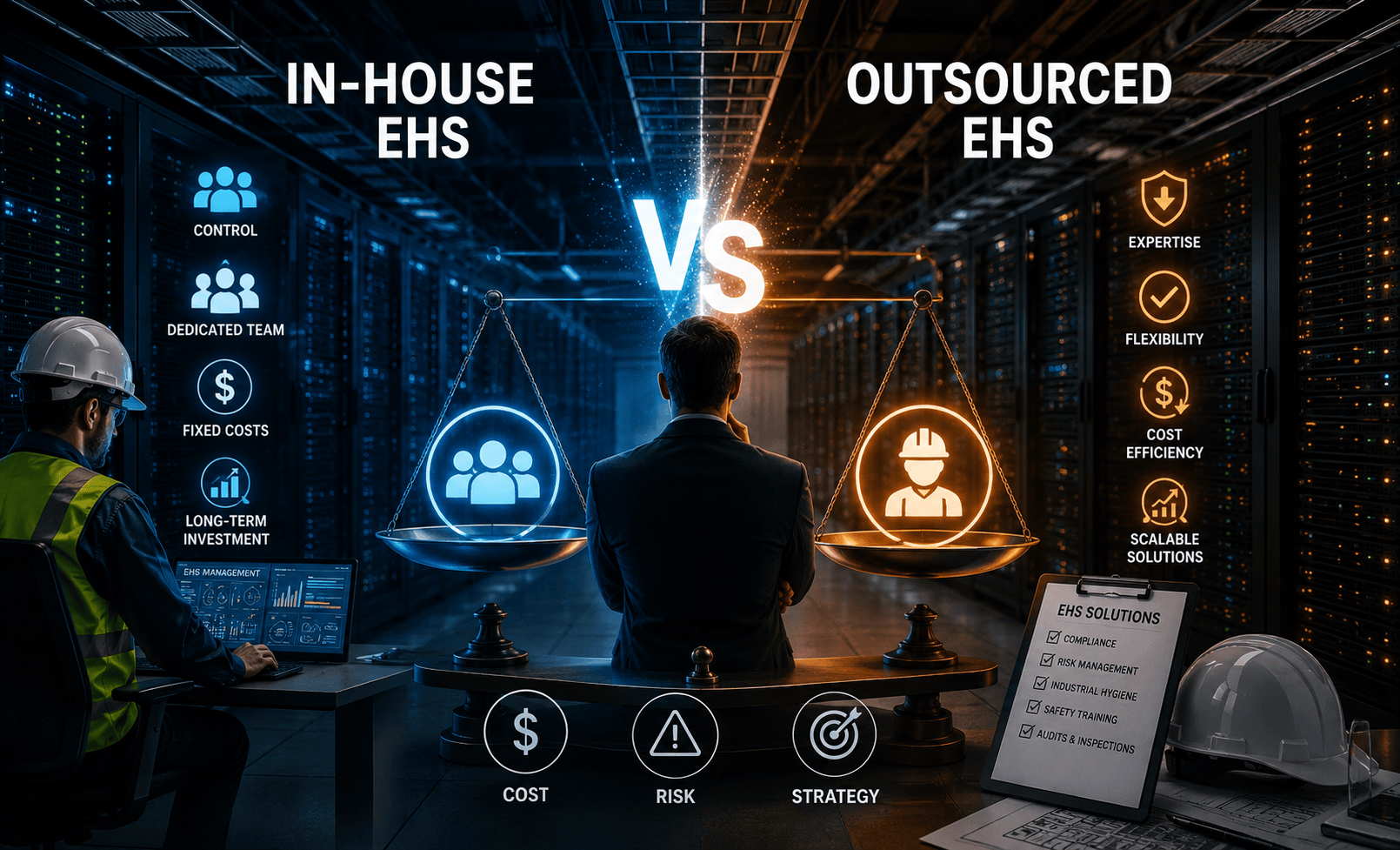
Choosing between internal teams and outsourced support often involves balancing multiple factors beyond cost alone. Organizations evaluating in-house vs outsourced EHS for AI data centers should consider expertise, flexibility, scalability, and long-term operational goals. The comparison below highlights several key areas commonly reviewed during EHS planning discussions.
While no single model fits every organization, evaluating these categories can help decision-makers determine which structure best supports operational growth and compliance objectives. As AI infrastructure expands, EHS strategies should remain adaptable and aligned with both current demands and future facility requirements.
Expertise Gap: A Major Risk Factor
One of the most overlooked issues in internal programs is the expertise gap.
AI data centers require knowledge across multiple disciplines:
Industrial hygiene
Electrical safety
OSHA compliance
Environmental health standards
Failing to address these areas can lead to compliance gaps and increased risk.
Resources from the Occupational Safety and Health Administration highlight the importance of specialized knowledge in workplace safety programs, especially in high-risk environments.
Scalability: Where Outsourcing Wins
As AI data centers expand, scalability becomes a defining factor in the in-house vs outsourced EHS for AI data centers decision.
Modern EHS programs rely on data to guide decisions.
Effective strategies include:
Continuous monitoring
Scheduled assessments
Predictive risk analysis
Real-time reporting systems
National EHS Support for AI Data Centers
Phase Associates provides industrial hygiene testing, OSHA safety and compliance training, and outsourced EHS services for AI data centers across the United States.
We support operations nationwide, including NJ (Atlantic City), NYC, PA (Philadelphia, Pittsburgh), GA (Atlanta), MD (Baltimore & DC Area), MA (Boston), MI (Detroit), Arkansas (Bentonville), and surrounding regions.
Our approach is designed to help organizations navigate the complexities of in-house vs outsourced EHS for AI data centers while building scalable, compliant programs.
Choose the Right EHS Model for Your AI Data Center
Deciding between an internal team and outsourced EHS for AI data centers comes down to more than cost—it’s about building a program that can adapt, scale, and perform under pressure.
Phase Associates works directly with AI data center operators to evaluate current safety programs, identify gaps, and implement solutions that align with operational demands and regulatory requirements.
From industrial hygiene assessments to nationwide compliance support, we help you determine the most effective path forward—whether that means enhancing internal capabilities or transitioning to a fully outsourced model.
As AI infrastructure continues to expand, operators are under increasing pressure to maintain safe, compliant, and efficient environments. This is where a structured AI data center EHS compliance checklist becomes essential.
Without a clear checklist, safety programs become inconsistent, compliance gaps emerge, and risks increase. A well-developed EHS compliance checklist for AI data centers ensures that every aspect of environmental health and safety is addressed—from industrial hygiene monitoring to Occupational Safety and Health Administration (OSHA) training and documentation
As highlighted in AI Data Center Safety Compliance in 2026, regulatory expectations are evolving rapidly, making proactive planning critical for long-term success.
Why Every AI Data Center Needs an EHS Checklist
AI facilities operate in complex, high-demand environments where even minor oversights can lead to major issues.
A comprehensive AI data center EHS compliance checklist helps:
Standardize safety procedures across teams
Identify risks before they escalate
Ensure regulatory compliance
Improve operational consistency
Reduce liability and downtime
For multi-site operators, a consistent EHS compliance checklist for AI data centers is especially important for maintaining uniform safety standards.
Core Categories of an AI Data Center EHS Compliance Checklist
To be effective, your checklist must cover all major areas of risk and compliance.
1. Workplace Hazard Identification
The first step in any AI data center EHS compliance checklist is identifying potential hazards.
Proper documentation is often overlooked but is a critical part of any EHS compliance checklist for AI data centers.
Your checklist should include:
Written safety programs
Standard operating procedures (SOPs)
Incident reports and logs
Inspection records
Compliance documentation
Accurate records are essential for audits and regulatory reviews.
6. Equipment and Facility Safety Checks
Routine inspections help prevent failures and ensure safe operations.
Checklist items include:
Equipment maintenance schedules
Cooling system inspections
Electrical system integrity checks
Fire protection systems
Emergency exits and signage
These checks help maintain both safety and operational continuity.
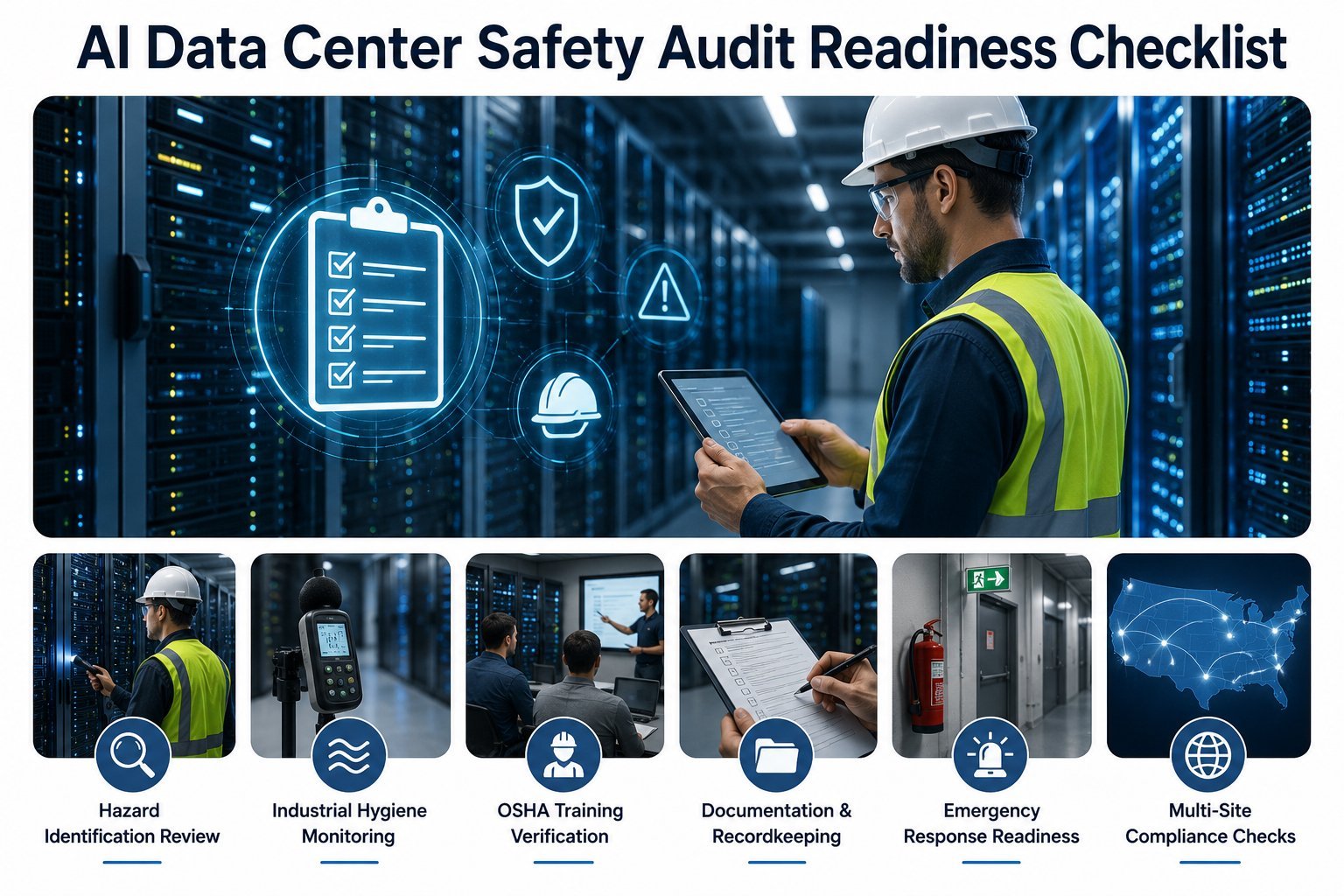
Preparing for an AI data center safety audit involves more than checking a few compliance boxes. Organizations should review hazard controls, industrial hygiene programs, workforce training, documentation systems, and emergency preparedness procedures before an audit occurs. The visual checklist below highlights key focus areas commonly reviewed during audit readiness evaluations.
An effective audit strategy requires ongoing review rather than last-minute preparation. Facilities that routinely evaluate these categories are often better positioned to identify compliance gaps early, improve workplace safety, and maintain stronger operational consistency across AI data center environments.
7. Multi-Site Consistency and Oversight
For organizations operating across multiple locations, consistency is key.
Your AI data center EHS compliance checklist should ensure:
Standardized procedures across facilities
Centralized reporting systems
Consistent training programs
Unified compliance tracking
This is critical for scaling operations without increasing risk.
Common Gaps Found in EHS Checklists
Even well-designed programs can have gaps. Identifying these early is essential.
Common issues include:
Incomplete monitoring schedules
Outdated training programs
Inconsistent documentation
Lack of multi-site coordination
Failure to adapt to new regulations
Addressing these gaps strengthens your EHS compliance checklist for AI data centers and improves overall safety performance.
How to Implement an Effective EHS Checklist
Creating a checklist is only the first step—implementation is what drives results.
Best Practices for Implementation
Assign clear ownership for each checklist category
Conduct regular audits and reviews
Use digital tools for tracking and reporting
Update checklists as regulations evolve
Integrate checklist items into daily operations
These practices ensure your AI data center EHS compliance checklist remains effective over time.
The Role of EHS Expertise in Checklist Development
Developing a comprehensive checklist requires expertise across multiple disciplines.
This includes:
Industrial hygiene
OSHA compliance
Risk assessment
Safety training
Organizations often rely on external experts to ensure their EHS compliance checklist for AI data centers is complete and up to date.
National EHS Support for AI Data Centers
Phase Associates provides industrial hygiene testing, OSHA safety and compliance training, and EHS consulting services for AI data centers across the United States.
We support operations nationwide, including NJ (Atlantic City), NYC, PA (Philadelphia, Pittsburgh), GA (Atlanta), MD (Baltimore & DC Area), MA (Boston), MI (Detroit), Arkansas (Bentonville), and surrounding regions.
Our team helps organizations build and implement effective AI data center EHS compliance checklists that align with both operational demands and regulatory requirements.
Turn Your EHS Checklist into a Scalable Safety System
A strong AI data center EHS compliance checklist is only effective when it’s properly implemented, maintained, and adapted as your operations grow.
Phase Associates works with AI data center operators to develop customized checklists, conduct industrial hygiene assessments, and ensure full OSHA compliance across single and multi-site environments.
From initial evaluation to ongoing support, we help transform your EHS compliance checklist for AI data centers into a complete, scalable safety program.
Contact Phase Associates today to strengthen your EHS strategy and ensure your AI data center is fully prepared for 2026 and beyond.